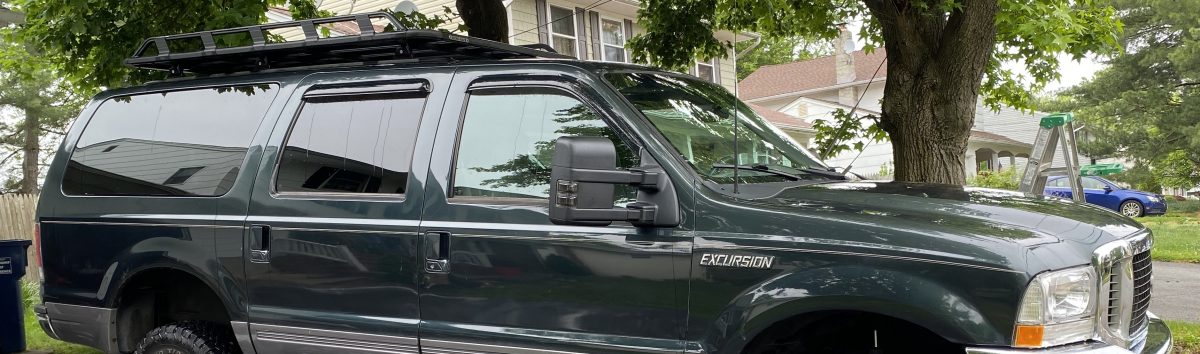
For some reason I started shopping for backpacking tents. But I couldn’t find one I liked. They all had one or more fatal flaws –
- Too heavy
- Too small when pitched
- Too large when packed
- Too expensive
But I think I may have found the perfect solution.
A tarp. Packs super small because no poles. Light because no walls or floor. I can set it up large enough to sleep all four of us.
So the downside of a tarp shelter here on the east coast is the potential to bleed out overnight because of insects. But if I hang a bug net under the tarp, I’ve got that sorted.
Did a dry run in the backyard over the weekend.

Because I’m me, I taught myself four new knots for this project. The ridge line has a marlinspike hitch, several Prusiks, an alpine butterfly loop and a trucker’s hitch.
The Marlinspike hitch is used to secure the beginning of the ridge line. It’s basically a slip knot around a toggle but it is directional. Tie it backwards and your toggle will slip out. I keep a bowline tied at the end of the ridge line. The bowline goes over the toggle.
The Prusik makes a loop that you can slide along the ridge line. Once there is tension on the Prusik it locks into place. I use a toggle through a loop on the tarp to connect the tarp to the Prusik. I have some extra prusiks on the ridge line to hang the bug nets, lanterns, and empty stuff sacks. Actually, I made the first set too small, the bends kept coming untied. I made the second set so long they look silly. Hopefully the third set will be, as they say “Just right”. (My prusiks are the fluorescent orange bits)
The Alpine Butterfly Loop lets you make a loop in the middle of a line that won’t move and is easy to untie. This is the loop I use for the trucker’s hitch, but you could use many other knots for the loop. This was the hardest of the four for me to master.
I use the Trucker’s Hitch to secure the second end of the ridge line. I pull a bight through the Alpine Butterfly Loop and tie the bight into two half-hitches to secure the line. Then I hank up the remaining ridge line to protect my line from dirt & debris as well as remove a trip hazard.
After the ridge is set, you lay the tarp over the ridge. Lock the tarp into the desired position with the prusiks. If, for example, you were hanging the tarp over a hammock, you’d want to center the tarp over the hammock. The prusiks allow you to position the tarp anywhere along the ridge.
The real beauty of the tarp is it’s flexibility. When I initially pitched it, the forecast showed zero chance of rain. With the Adirondack pitch, we could hang our heads out the open end and look at the stars, but I couldn’t get the end of the mattress totally under the roof because the back wall was too steep.
While we were at dinner, the forecast changed and we were expecting rain to start before dawn. Rather then wake up wet, I decided to re-set the tarp after dinner.
In the dark.
I could have rotated the bed 90 degrees, but I didn’t want to lay across the slope.

If you look, you can see that I hung the tarp crookedly. The left side is centered, but the right side is one loop forward of center. The right side is where I wanted it. No big deal though, our bed is fully covered.
It did rain (drizzle actually) twice overnight, so I’m glad I did the reset.
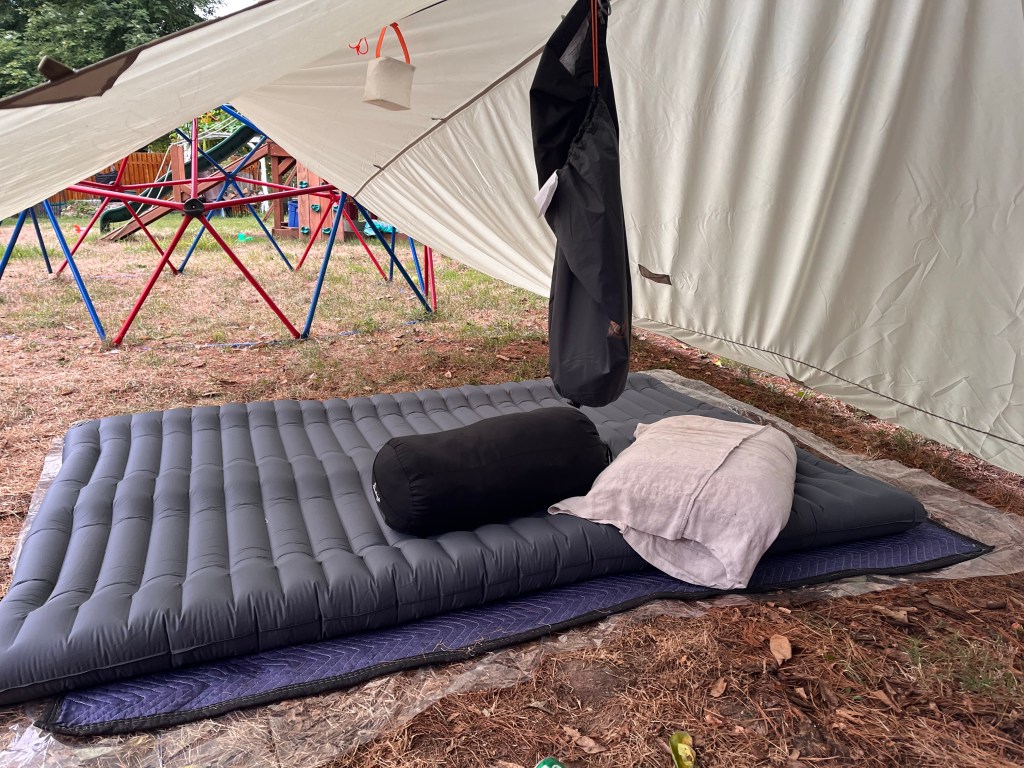
I like a neat & tidy campsite. The ridge line makes an excellent place to store empty stuff sacks. The tarp has three loops on the underside. I used one of them to hang my eyeglasses. In the future, those loops might be used to suspend the bug nets or the bug nets might be suspended from the ridge line.
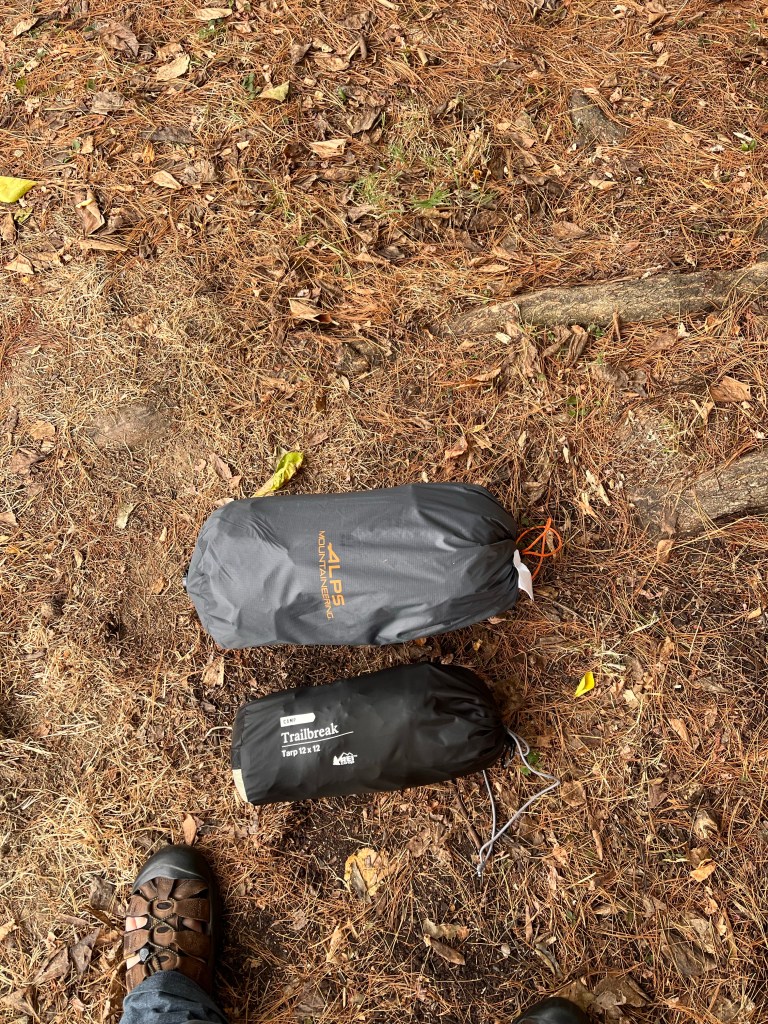
The larger stuff sack is the double wide air mattress. The smaller one contains the tarp, six stakes & six guy lines that REI included as well as the 50’ ridge line with prusiks, three toggles, and a polycro ground sheet sized for the double mattress. My size 10 foot for scale.
The tarp itself is about three pounds. Adding the ridge line, double bug net and polycro ground sheet is about three and a half pounds. If I add two single bug nets and two single ground sheets for the kids, I’m still going to be less than five pounds, which is insane for a four person tent. The other huge advantage to this shelter is that I can easily separate the bits and spread the weight across everyone’s pack.
Downside – the 12×12 is huge. To pitch it between two trees, I need them to be 15 feet apart at a minimum. Alternately, I may work out a trekking pole pitch so I can set up in the middle of a field. If I find myself on solo trips, I’ll probably shop for a 3 meter or 10×10 tarp.
One advantage that a tent has over a tarp is that you can point a tent whichever way is needed to have your head uphill. With the tarp, your ridge must go between two trees. If you want to sleep with your head uphill (and you do) your bed might have to be set at an odd angle to the ridge line.
Legal jibber-jabber
- As an Amazon Affiliate, I may earn commission if you purchase something linked from this page.
- Product reviews – unless stated otherwise, I have purchased all reviewed products with my own money.
- “Manufacturers claims” are exactly that. Their claims. If my text says “manufacturer claims” it means I haven’t checked it and I probably don’t have a way to check it. Hydrostatic ratings, R-values, Temperature ratings, etc.
- Follow these instructions at your own risk. I’m not a professional anything. I’m just some random human you encountered on the internet. I may or may not have any idea what I’m doing. I certainly have no idea what you’re doing. I accept no liability for injury, property damage or any other direct or indirect damages you may incur from anything on this page or any other pages I may or may not have authored.
- Copyright Reserved Creative Commons – Attribution, Non-Commercial, Share Alike . If I’ve inspired you, link back to this page. Don’t steal my text or photos. Feel free to modify my designs in any way you see fit. Don’t try to make yourself money from my ideas.
- Comments will be moderated. Those that add to the discussion will be allowed. Those that add nothing will be deleted. If you don’t agree with my decisions, get your own website.
- DON’T PANIC

 Modern Anachronist