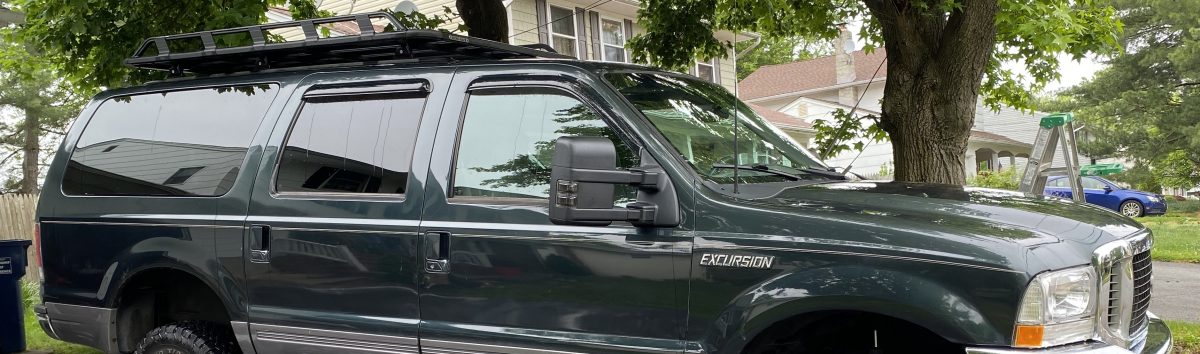
This is my first tarp, but I’m confident it won’t be my last. I purchased the REI Trailbreak Tarp. After playing with it in the yard for a few days and sleeping under it one night, here are my first impressions.

Why a tarp over a tent?
As I stated in my first tarp post, it seemed like there were too many compromises to be made for me to buy a backpacking tent if I wasn’t actually planning a backpacking trip. (I’ll never get the wife backpacking). The tarp seems to fix all the compromises – it’s cheap, light, packs small & pitches huge.
What’s in the box?
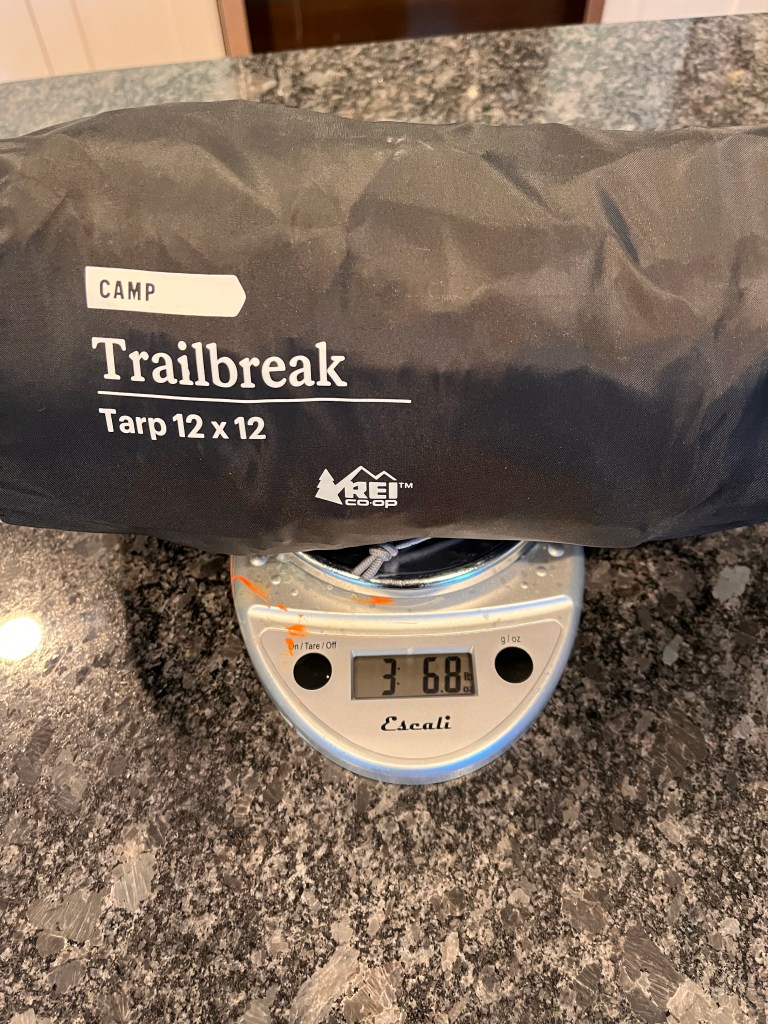
The tarp itself is 12×12, 144 square feet. Retail price (Sept 2022) is just shy of $80. It is packed in a stuff sack with six useless aluminum stakes and six reflective guy lines premade with plastic toggles at one end and a jam cleat based adjuster at the other. Packed weight of the tarp and all accessories is two pounds, nine ounces according to REI.
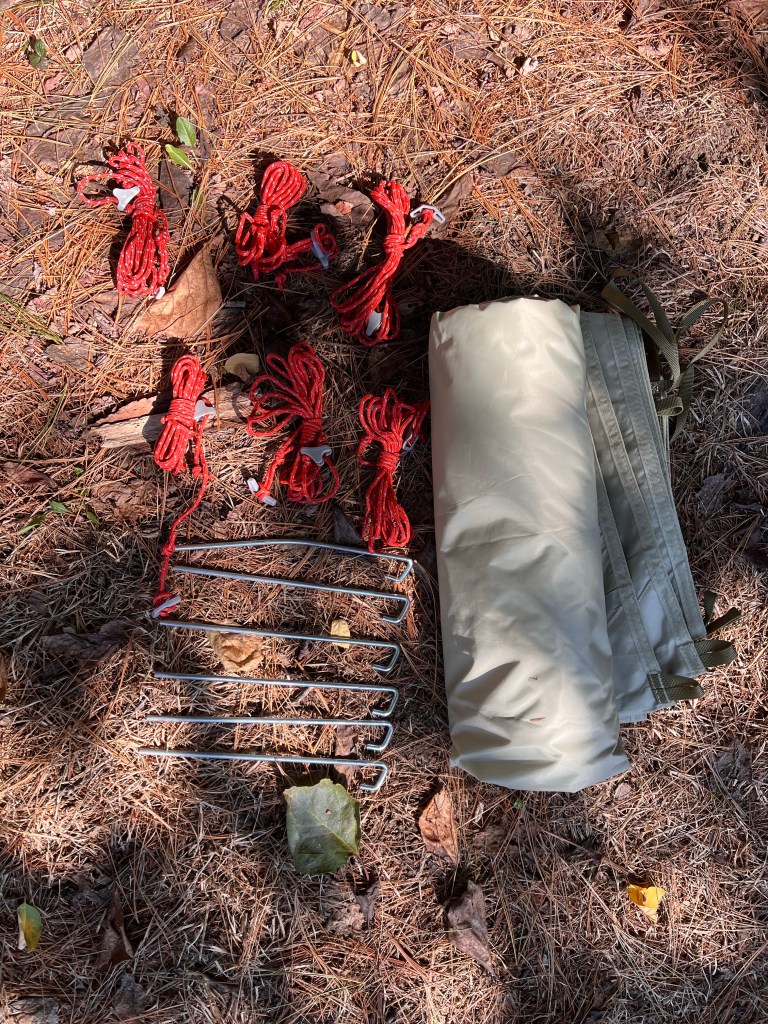
I’m curious to see how long the plastic toggles hold up, but the adjusters will probably get binned fairly quickly. I’ve never found an adjuster that worked as well as a taut line hitch, though these aren’t terrible. Also, any hardware (even plastic) is heavier than no hardware. The guy lines seem too long, but I’m not ready to cut them just yet.
This tarp has more attachment points than I imagined. There are five webbing loops on each edge, plus five more making a cross on the center line in each direction. Surprisingly, there are three loops on the underside of the tarp on the centerline. A grand total of 21 attachment points on top and three underneath.
How big is it?
While the tarp is 144 square feet, you’ll never get that much sleeping space, because it’s going to be at an angle. Quick geometry says that if I hang the ridge line four feet in the air and bring both edges to the ground I’ll have a 9×12 floor or 108 square feet. If you decrease the slope of the roof, either by lowering the ridge line or using guylines on the corners instead of staking them down, you get a lot more space under cover.
With a 12 foot long ridge, you could put six 24” wide sleeping pads side by side in there, but if it rains the person on the windward side would get soaked. Four people side by side should be fine.
What did I change?
Before I even took it out of the bag, I made up a ridge line. A 50’ length of paracord with a bowline at one end and Prusiks attached. I also made up three quick wooden toggles. The ridge line and toggles fit inside the stake bag.
On the east coast, moisture seeping from the ground is a full-time issue not just on rainy days. If you’re going to put a sleeping bag under the tarp you’ll want a ground sheet. I bought this Polycro groundsheet from Gossamer Gear (3.8 oz, $11). Designed for a two person tent, it protected my double mattress perfectly. It also fits inside the stuff sack. I’m not sold on the long term durability of polycro. I may see if I can source a Tyvek ground sheet, though at $11 I can afford to replace this one without losing any sleep.
I’ve got a bug net on the way. This is something that won’t always be needed depending on where and when you camp. Hopefully it will be easy to hang from the ridge line.
How was it?
Once I got the ridge line up, setting the tarp was easy. There was no wind to speak of, working with 144 feet of sail on a breezy day might be more of a challenge. Place a toggle through the loop you want on the ridge line, hook the Prusik over both ends of the toggle and pull tight. Keep a bit of tension on the tarp as you go to the other end so the toggle doesn’t fall out and repeat.
Once the top of the tarp is attached to the ridge line it’s a simple matter to stake out one corner at a time to build your shelter. If you want to block the wind, pin the edge to the ground. If you want a breezy shelter, attach guylines to the corner and stake the guylines.
One difference between a tarp and a tent is that there is no “right” place for the stakes with a tarp. With a modern tent, you put the poles up and the tension between poles & fabric locates the stakes. You then pin the tent down to keep it from blowing away.
When using the tarp, the stakes are used to put tension on the fabric. You will probably have to tweak the positions of each stake to make the tarp lie perfectly.
One of the six stakes has already bent. I’ll probably replace them with something more durable fairly quickly.
Final thoughts
If I’m camping alone, or with just one of the kids, this tarp might actually be too big. REI offers a 10×10 tarp at 12 ounces for $180 (it was on sale for $125 this past Labor Day). {note – this is why I hate ultra light gear. Yes it’s a lot lighter at 12 v 33 ounces, but it’s smaller and more than twice the price}. I’m sure if I shop around I can find one with a price / size / weight ratio that makes me happy. This Klymit 10×10 is $44 and 24 oz.
If you like to experiment with your gear a tarp is definitely better than a tent. If you want the same shelter every night, stick to a tent.
The other advantage of the tarp is it’s modularity. I can pack ground sheets and bug nets for the number of people on this trip.
Legal jibber-jabber
- As an Amazon Affiliate, I may earn commission if you purchase something linked from this page.
- Product reviews – unless stated otherwise, I have purchased all reviewed products with my own money.
- “Manufacturers claims” are exactly that. Their claims. If my text says “manufacturer claims” it means I haven’t checked it and I probably don’t have a way to check it. Hydrostatic ratings, R-values, Temperature ratings, etc.
- Follow these instructions at your own risk. I’m not a professional anything. I’m just some random human you encountered on the internet. I may or may not have any idea what I’m doing. I certainly have no idea what you’re doing. I accept no liability for injury, property damage or any other direct or indirect damages you may incur from anything on this page or any other pages I may or may not have authored.
- Copyright Reserved Creative Commons – Attribution, Non-Commercial, Share Alike . If I’ve inspired you, link back to this page. Don’t steal my text or photos. Feel free to modify my designs in any way you see fit. Don’t try to make yourself money from my ideas.
- Comments will be moderated. Those that add to the discussion will be allowed. Those that add nothing will be deleted. If you don’t agree with my decisions, get your own website.
- DON’T PANIC

 Modern Anachronist