Four years in this house and the plan for the vegetable garden is finalized. (I think. The wife might not be settled yet.)
Five raised beds surrounding a garden shed / work space. But now we outgrew the irrigation system that I threw together when we were prepping to be out of town for two weeks and she didn’t want the garden to die.
I’m a gas utility worker by trade, so I’m used to working with valves and fittings, but water isn’t something I deal with on a regular basis.
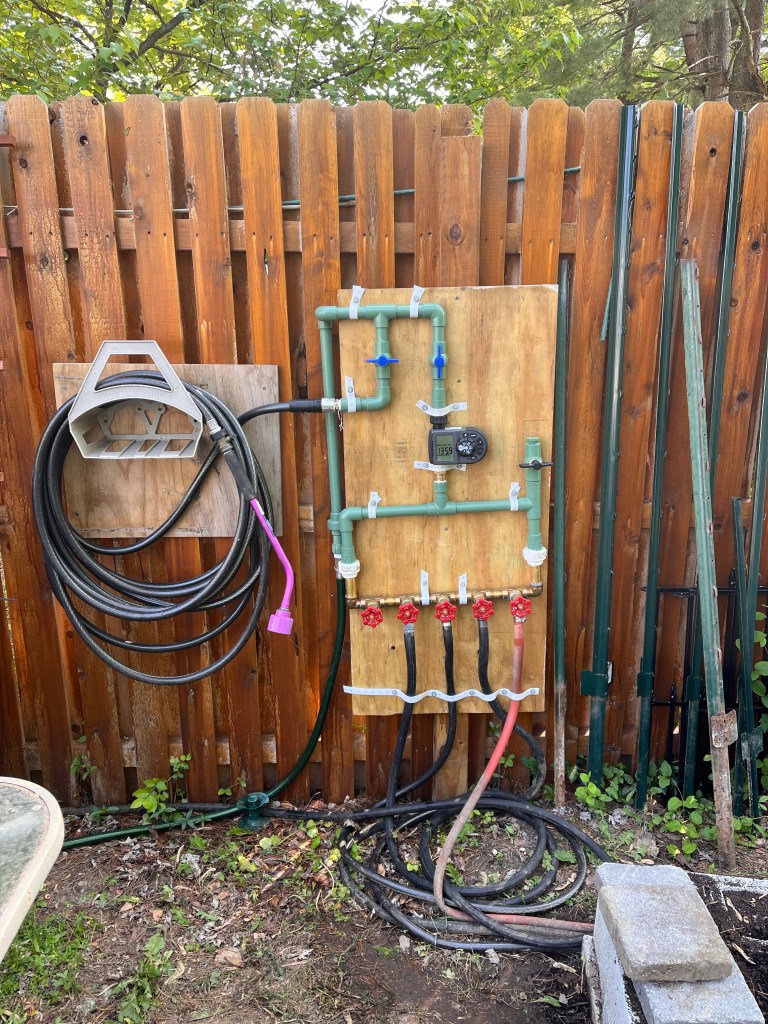
The manifold is made of PVC and brass. Each raised bed is fed by a gate valve* so my wife can adjust how much water each one gets. There is a ball valve* on the right so I can hook up an air compressor in the fall to blow the water out of the lines. The ball valve on the left is for the convenience hose. She uses that for watering pots. The timer in the center feeds the soaker hoses in each raised bed every morning.

The manifold itself is fairly simple. Each bed requires a gate valve and a T-fitting.
The T’s are joined by 2” nipples. The two inch nipples keep the manifold relatively compact but still give my fat fingers room to turn the valves.
At each end I used a street elbow, a short nipple and a threaded union to convert from brass to PVC.
The hard part is getting the connections tight while keeping everything lined up. And brass is soft, so you can’t just put a pipe wrench and use gorilla strength.
The way I got the T’s aligned was to screw an iron pipe nipple into the bull of each T. I used that length of iron pipe as a place where I could use my pipe wrench without marring the brass. It’s also easier to see if a 6” length of pipe is pointing the wrong direction than a half inch long T.

Once the T’s are all tight and aligned, it’s time to do the street elbows. Same trick, use a bit of iron pipe as a place to put your wrench and get the fittings pointed the right way.
The valves are a bit different. The garden hose thread on the outlet end of the valve is different than the pipe thread everywhere else, so the pipe nipple trick won’t work. But the valves are made with flats so you can grab them with a wrench. An adjustable wrench has smooth jaws, so it won’t chew up the brass, if you’re careful.
Work from one end to the other, because the valves are too close to swing the wrench in between them.
Once the brass bits were done, I started on the PVC upper section.
Why two different materials? I’m used to working with threaded pipe, so that seemed natural. But brass pipe is expensive. And I’m not sure how long iron pipe would last in constant contact with water.
* Gate valve vs. Ball valve.
Different valves have different functions and constructions. A ball valve is one most people experience. The flow of gas or water is stopped by a ball with a hole drilled through it. The operator turns the handle (ball is attached to the handle) one quarter turn from fully open to fully closed.
A gate valve has a gate that is lowered and raised on a screw to close or open. The operator has to turn the handle several full rotations to fully open or close the valve.
Ball valves are less likely to leak, but generally speaking, they aren’t repairable once they do leak.
Ball valves are either on or off, while gate valves can be used to partially restrict flow.
It’s quite easy to see if a quarter turn handle is on the opened or closed position (see the lead photo on this post), while one needs to handle a gate valve to know (hopefully) whether it’s opened or closed.

 Modern Anachronist